How It Works
The pipeline from idea to merged code
Fabrika runs every task through a six-stage pipeline. You stay in control — nothing merges without your approval.
The pipeline
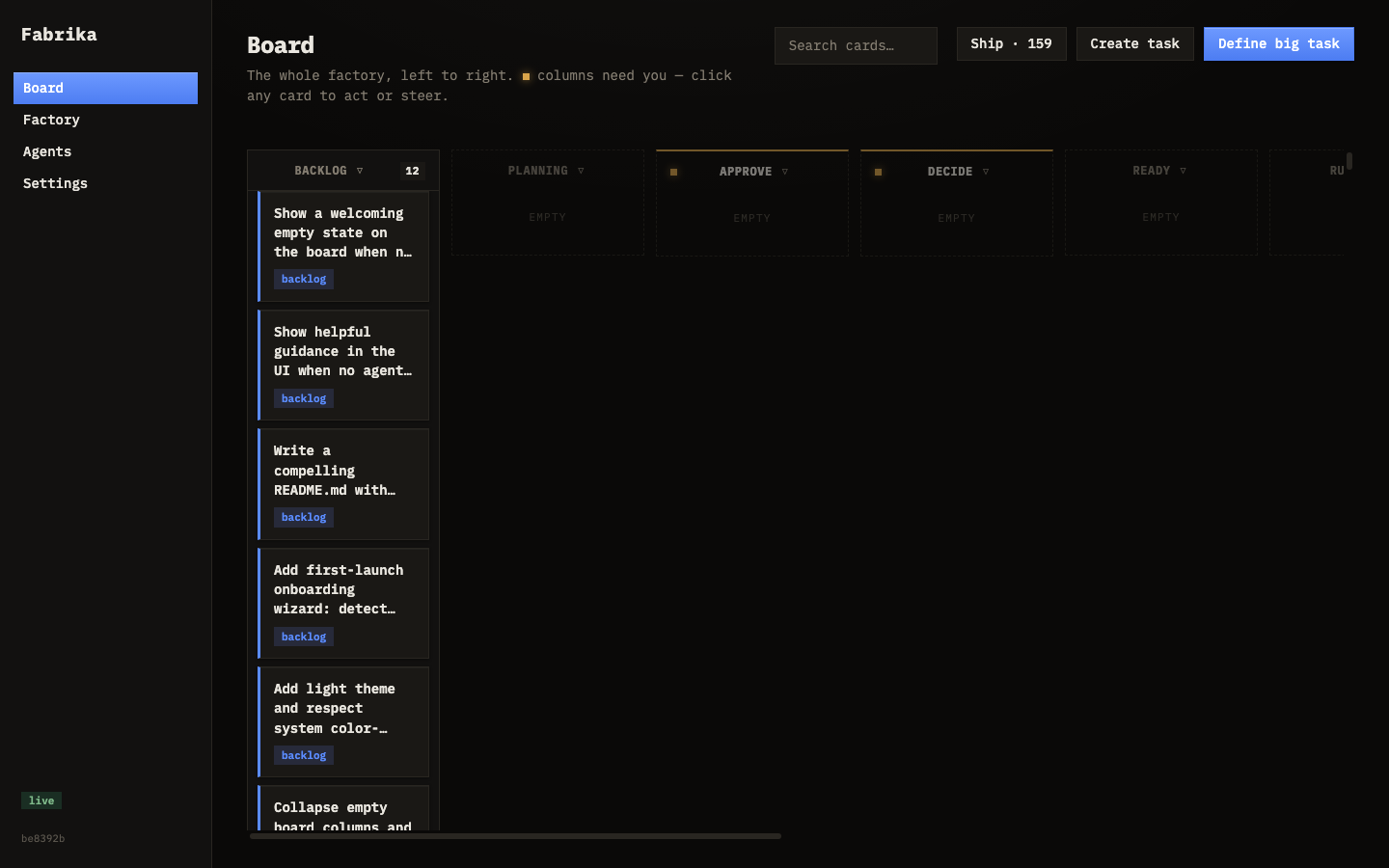
When you create a task, it moves through these stages on the board:
01. Plan
For big tasks, a planner agent chops the work into smaller, independently buildable pieces. Each piece becomes a task on the board with its own spec, touch paths, and acceptance criteria. See Big Tasks for details.
02. Write
An implementer agent writes the code. It works in an isolated branch — nothing touches your main code until you approve it.
03. Test
The agent writes (or updates) tests alongside the implementation. Fabrika doesn’t allow code without coverage.
04. Verify
Every change goes through automatic checks: build, lint, test suite, and mutation testing. If any gate fails, the task is kicked back to the agent.
05. Review
The task lands on your board in the Review column. Click it to see the diff, test results, and agent’s notes. One click to accept or reject.
06. Merge
Only when you click Accept does the code land in your repo. Fabrika never merges without your explicit say-so.
Decisions and conventions
Sometimes agents need your judgment. When they hit an ambiguity — which library to use, which approach to take — they surface a decision in the Decide column for you to answer.
If you promote an answer to a convention, it becomes a standing rule injected into every future agent prompt. Conventions are how the factory learns your preferences over time.
The human role
You’re not writing code. You’re making choices, reviewing output, and steering direction. Fabrika handles the implementation — you handle the intent.
The board is your cockpit: scan columns for things needing your attention, review diffs, accept good work, and steer when agents go off track.